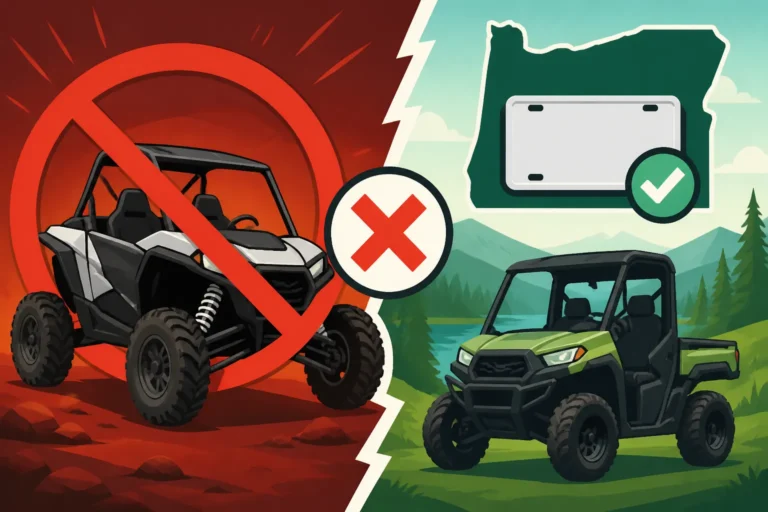
Oregon Fines for Riding a Closed Road
Picture this: You've loaded up the side-by-side, driven for hours to your favorite Oregon riding spot, maybe somewhere out in the Tillamook State Forest or near Millican Valley. You're ready to hit those trails, feel the wind, and escape the daily grind. But then, you round a corner, and there it is—a "Road Closed" sign, maybe a locked gate, or even just some hastily placed logs. Your heart sinks. What now? Do you turn back, or do you risk it? Many riders face this dilemma, often without fully understanding the serious consequences of riding a closed road in Oregon. This guide is here to unravel the complexities, clarify the rules, and help you avoid those frustrating and potentially costly fines.
Understanding Road Closures in Oregon
It’s easy to get frustrated when you encounter a closed road, especially after you've made the effort to get out and ride. You might wonder if the closure is really necessary or if it's just an inconvenience. However, these closures are rarely arbitrary. They're put in place for very specific and often critical reasons, ranging from public safety to environmental protection. Knowing why a road is closed and who is responsible for that decision can help you understand the situation better and plan your rides more effectively.
Reasons for Road Closures
Roads don't just close for fun; there's always a compelling reason behind it. One of the most common culprits, especially during the dry summer months, is fire danger. Oregon experiences severe fire seasons, and closing roads in high-risk areas protects both the public from potential danger and prevents new fires from being started, whether accidentally or intentionally, by limiting access. Another major factor is weather damage. Heavy rains can lead to washouts, mudslides, and downed trees, making roads impassable or even dangerous. Winter brings snow and ice, which can make higher elevation roads treacherous or completely block them. Repairing these damages can take a significant amount of time, and until they're safe, roads remain closed.
Beyond natural events, human activities also play a big role. Logging operations frequently necessitate road closures. Active hauling involves massive, fast-moving equipment like log trucks and heavy machinery, creating extremely hazardous conditions for recreational riders. These closures protect both the loggers and the public. Similarly, closures can be implemented for wildlife protection, especially during sensitive breeding or nesting seasons. For instance, specific areas might close for [Snowy Plover Season on the Oregon Coast] to protect these vulnerable birds, or you might see [Prospect's Green Dot Elk Closure] to minimize disturbance to elk herds. Finally, some roads are simply unmaintained due to budget constraints or land management decisions, and they are closed to prevent damage to vehicles and injury to users, as well as to prevent environmental impact.
Who Closes Roads
The authority to close roads in Oregon is spread across various agencies and entities, which can sometimes make things a bit confusing for riders. The U.S. Forest Service is responsible for roads within National Forests, like the Willamette or Umpqua National Forests. They implement closures for fire, timber sales, and environmental reasons. Similarly, the Bureau of Land Management (BLM) manages vast tracts of public land and their associated roads, often found in central and eastern Oregon. They too have the power to close roads for similar reasons.
On the state level, the Oregon Department of Forestry (ODF) manages Oregon's State Forests, such as the popular Tillamook State Forest, and they have the authority to close roads for logging, weather, or fire danger. County governments maintain County Roads, and they can close them for maintenance, public events, or severe weather. Finally, many private timber companies own extensive land holdings in Oregon and often allow public access on their roads, but they retain the right to close those roads at any time, often with little notice, especially during active logging or fire season. Even [The Oregon Parks and Recreation Department's Role] might involve closures within specific OHV park boundaries for maintenance or safety. Understanding which agency manages the specific piece of land you're on is crucial for knowing where to look for closure information.
Navigating Different Jurisdictions
The reality of riding in Oregon is that you rarely stay within a single jurisdiction for an entire ride. It's common for a single route to start on BLM land, briefly cross a segment of private timberland, and then transition into a National Forest. This creates a patchwork of rules and potential closures, making pre-ride planning absolutely essential. What might be open on one side of a property line could be strictly closed on the other. For example, [Riding a County Road in Grant County, Oregon] might be allowed under county ordinances, but if that road then enters a National Forest, Forest Service rules immediately apply.
Each of these entities—whether federal, state, county, or private—operates with its own set of regulations and a distinct approach to managing access. This means a fire closure on Forest Service land might not extend to adjacent BLM land, or a timber company might open its gates only on weekends, while the county road leading to it is open all week. This complexity requires riders to be diligent in their research and aware of their surroundings at all times. Simply put, you can't assume that if one road is open, all connecting roads are too. This is why having current, accurate information for all the jurisdictions you might encounter is so important, often requiring a multi-faceted approach to checking for updates.
Identifying a Closed Road
So, you're out on the trail, enjoying the ride, and then you spot something that looks like a closure. How do you know for sure if a road is off-limits? It's not always a giant, unmistakable barricade, and relying solely on what you see on the ground without cross-referencing can lead to trouble. Being vigilant and knowing where to get reliable, up-to-date information is your best defense against inadvertently riding into a closed area and facing those unwelcome fines.
Reading Closure Signs
The most immediate indicator of a closed road will be a sign or a physical barrier. These can vary widely in appearance and formality. At one end of the spectrum, you'll encounter official Forest Service or BLM gates, often made of heavy metal, clearly marked with "Road Closed" or "Area Closure" signs, and sometimes even locked. These are usually quite unambiguous. However, don't assume a road is open just because it doesn't have a giant concrete barrier. Often, especially in less-traveled areas, you'll see a simple "Road Closed" sign, maybe a few strategically placed logs, a pile of earth, or even just a rope or chain pulled across the path. These simpler barriers, while not as imposing, carry the same legal weight.
It's crucial to pay attention to any signage, no matter how rudimentary it appears. Sometimes, you might see signs indicating seasonal closures, like "Closed for Winter" or "Fire Closure in Effect." Even a basic "No Trespassing" sign can denote an unpermitted closure if you've transitioned onto private land without realizing it. The key is to look for any indication that access is restricted. If the intent to close the road is clear, even if the barrier seems easy to bypass, you are expected to respect it. Ignoring such signs is a deliberate act of violation, not an oversight, and will be treated as such by enforcement officers.
Consulting Maps and Digital Resources
While on-the-ground signs are important, they can sometimes be missed or even vandalized. This is where pre-ride planning with up-to-date maps and digital resources becomes indispensable. Official agency websites are your absolute best source of information. The U.S. Forest Service, Bureau of Land Management, and Oregon Department of Forestry all maintain websites with current alerts, news releases, and often interactive maps that show specific road and trail closures. Make it a habit to check these resources just before you head out, as conditions can change rapidly, especially during fire season or after severe weather.
Many riders also use offline GPS apps on their phones or dedicated GPS units. These can be incredibly helpful for navigation, but they come with a significant caveat: they need to be frequently updated. A map that's a year old might not reflect recent closures. Even the best GPS units, especially those mounted on a rugged SuperATV dash, can have outdated map data. Always cross-reference your digital maps with official online sources. Additionally, be aware that sometimes [Maps That Disagree With Signs] can lead to confusion. If your map shows a road as open but there's a "Road Closed" sign on the ground, always defer to the sign. It's the most current and legally binding information. Printing [Oregon Trail Maps Worth Carrying] and noting down any current closures is an excellent practice.
The Peril of Unofficial Information
In the age of social media and online forums, it's easy to get caught up in the chatter of other riders. While community insights can be valuable, relying solely on unofficial information about road conditions and closures is a perilous path. That casual mention in an online forum that "Road X is clear now" might be well-intentioned, but it could also be outdated, inaccurate, or based on someone else's risky choice to disregard a closure. What one person considers "passable" another might recognize as a blatant violation.
Enforcement agencies do not accept "I saw it on Facebook" as a valid defense for riding a closed road. Their jurisdiction and authority are based on official postings and regulations, not crowd-sourced opinions. Always be wary of information that isn't directly from the land management agency responsible for the area. If you hear whispers about a road being open or closed, use that as a cue to go directly to the official sources—the agency's website, phone line, or local office—to verify. The small effort of verifying information can save you a significant amount of money and aggravation, preserving your riding privileges and your peace of mind.
The Legal Ramifications: Fines and Penalties
So, what actually happens if you're caught riding on a closed road in Oregon? It's not just a polite request to turn around. The consequences can range from hefty fines to more severe penalties, impacting your wallet, your machine, and your future access to riding areas. Enforcement officers take these violations seriously, as closed roads are often indicative of real dangers or sensitive environmental concerns.
Oregon's Class C Traffic Violation and Related Fines
While riding a closed road specifically isn't always listed as a single, standalone infraction like a speeding ticket, it often falls under broader categories of violations. These can include trespassing, operating a vehicle off designated routes, or disregarding official signs or barriers. In Oregon, many OHV-related infractions, including those for improper operation or lack of necessary permits, can be classified as a Class C Traffic Violation. This designation means you're looking at a significant monetary penalty. The exact [What a Class C Traffic Violation Costs] can vary, but it's typically a base fine that can then have additional fees and court costs added on top, easily pushing the total well into hundreds of dollars.
Beyond the initial financial hit, being cited for a Class C violation goes on your record. While it might not affect your standard driving record in the same way a car speeding ticket does, it establishes a history of non-compliance with OHV regulations. For example, if you're caught riding a closed road in an area that also requires an Oregon ATV operating permit, you might face both a specific "closed road" violation (if applicable) and an [Oregon Fines for Riding Without a Permit]. Enforcement officers are trained to identify multiple infractions during a single stop, meaning a single encounter could result in several different citations stacking up, multiplying your costs and headaches.
Consequences Beyond the Fine
The financial penalty is just one piece of the puzzle. The ramifications of riding a closed road can extend far beyond a simple fine, leading to significant inconvenience and expense. One of the most severe consequences is machine impoundment. A ranger, sheriff's deputy, or Oregon State Police officer has the authority to seize your ATV or UTV if you're found to be in egregious violation of land use rules, or if you're deemed to be repeatedly disregarding closures. Getting your machine back from impound can be an expensive, bureaucratic nightmare involving towing fees, storage costs, and administrative hurdles that easily dwarf the initial fine. Imagine having your pride and joy, maybe a heavily modified SuperATV machine, towed away and impounded, ruining your weekend and costing you potentially thousands to retrieve.
Furthermore, if your actions cause any damage to the closed road, barriers, or the surrounding environment—such as tearing up a sensitive area, damaging a newly repaired section, or breaking a gate—you could be held liable for the repair costs. These costs can be substantial, especially for environmental remediation. If the closed road is on private timberland, ignoring a "Road Closed" or "No Trespassing" sign can quickly escalate to criminal trespass charges, a far more serious offense than a simple traffic violation. Repeated violations could also lead to a loss of riding privileges in certain areas or, in extreme cases, a statewide ban. These are not minor inconveniences; they are serious legal and financial burdens that can have long-lasting effects on your ability to enjoy Oregon's incredible OHV opportunities.
Enforcement and Patrol
It's a common misconception that remote riding areas are unpatrolled and that the chances of getting caught on a closed road are slim. This simply isn't true. Various law enforcement and land management agencies actively patrol Oregon's OHV areas, especially during peak riding seasons and in known trouble spots. These include Oregon State Police, County Sheriff's Deputies, U.S. Forest Service Law Enforcement Officers, Bureau of Land Management Rangers, and staff from the Oregon Parks and Recreation Department.
These officers are often seasoned professionals with extensive knowledge of the local trails and roads. They know which areas are frequently closed and which routes riders might be tempted to sneak through. Rangers and deputies are out there, especially on busy weekends, at popular staging areas like [Spinreel] or [Browns Camp], looking for compliance with permits, safety gear, and, crucially, adherence to posted closures. They utilize various methods, from marked patrol vehicles to unmarked rigs, and even on-foot patrols in dense trail systems. Their presence isn't just about catching violators; it's also about educating riders, ensuring safety, and preserving the natural resources that make these areas so appealing. If you're riding in a closed area, assume you could be spotted at any time.
Avoiding Closed Road Violations
The best way to deal with the fines and frustrations of riding a closed road is simply to avoid the situation entirely. This isn't about guesswork or hoping for the best; it's about being prepared, informed, and respectful of the rules. A little bit of proactive planning and common sense can save you a lot of headache, money, and ensure you continue to have access to Oregon's fantastic riding opportunities.
Pre-Ride Planning and Research
The single most effective strategy for avoiding closed road violations is comprehensive pre-ride planning and research. Never assume a trail or road you rode last year is still open. Conditions, ownership, and regulations can change rapidly. Before you even load your machine onto the trailer, make it a habit to:
- Check Official Websites: This is your primary source. Visit the websites of the specific land management agencies for your intended riding area (e.g., US Forest Service, BLM, Oregon Department of Forestry, county websites). Look for news releases, alerts, and interactive maps that clearly mark current closures. These sites are updated regularly and are the most authoritative sources.
- Call Ahead: A quick phone call to the local ranger district or BLM office for the area can provide invaluable, real-time information. A friendly chat with a staff member might clarify confusing map details or warn you about recent, unposted closures.
- Download and Review Current Maps: Always use the most up-to-date maps available. Many agencies offer digital maps that can be downloaded to your phone or GPS device. Review them thoroughly for any marked closures or restricted areas. Print copies of [Oregon Trail Maps Worth Carrying] and highlight your planned route.
- Know the Rules: Understand the specific regulations for the area you're visiting. Different areas have different seasonal closures, noise limits, and equipment requirements, such as the [Oregon Spark Arrester Requirement]. Being informed about all local rules demonstrates responsibility and reduces the chance of accidental infractions.
This disciplined approach to gathering information ensures you head out with the most accurate picture of where you can and cannot ride, minimizing surprises on the trail.
On-Trail Vigilance and Common Sense
Even with the best pre-ride planning, conditions can sometimes change unexpectedly, or you might find yourself on a section of trail you hadn't thoroughly researched. This is where on-trail vigilance and common sense become your crucial allies.
First and foremost, always be scanning for signs, markers, or barriers. They might be subtle—a faded sign, a few rocks strategically placed, or a low-hanging chain that wasn't there before. Don't be so focused on the trail ahead that you miss these critical warnings. If you encounter any form of barrier, even if it looks easy to bypass, respect it. These barriers are there for a reason, whether it's for safety, environmental protection, or active operations like logging. Ignoring them can lead to serious consequences, not just legal ones, but also personal injury or damage to your machine.
If you find yourself in doubt—if a sign is ambiguous, if a path looks unusually overgrown, or if you simply get a "bad feeling" about a route—turn around. The risk is almost never worth the reward. There's always another trail, another viewpoint, another adventure to be had without pushing into restricted territory. Even if your rig, perhaps equipped with heavy-duty SuperATV suspension, can handle a rough, unmaintained road, that doesn't make it legal or safe. Being a responsible rider means making smart, safe choices that protect both yourself and the riding resources we all share.
The Importance of a Designated Route
Oregon has a very clear philosophy when it comes to OHV use: stick to designated routes. This isn't just a suggestion; it's a fundamental rule designed to protect natural resources and ensure public safety. Not every dirt track or gravel road you encounter is legally open to ATVs or UTVs. Often, roads are closed because they are unmaintained, pass through sensitive habitats, or are actively used by logging operations.
Understanding what constitutes a "designated route" is key. These are clearly marked trails and roads explicitly designated for OHV use by the managing agency. Veering off these routes, even onto what appears to be a passable old logging road, is considered off-trail riding and is generally illegal. For example, [Oregon Rules for Riding a Forest Road] and [Oregon Rules for Riding a County Gravel Road] highlight that not all roads are open to OHVs, and special designation or specific conditions must be met. Riding off-route contributes to erosion, disturbs wildlife, and can lead to permanent closures of entire riding areas. By consciously staying on designated trails, you not only avoid potential fines but also contribute to the long-term sustainability of OHV riding in Oregon. It’s about being part of the solution, not the problem, to ensure future generations can also enjoy these amazing landscapes.
Specific Scenarios and Exceptions
While the general rule is "don't ride on closed roads," there are often specific scenarios or limited exceptions that riders inquire about. It's important to understand these distinctions clearly, as misinterpreting an exception can still lead to a violation. These aren't loopholes but rather specific conditions under which certain activities are permitted, often with strict caveats.
Oregon Agricultural Road Use for ATVs
For those involved in farming and ranching, ATVs and UTVs are often essential tools for daily operations. If you're using your machine for legitimate agricultural purposes—say, hauling feed, checking fences, or transporting tools on your own property or adjacent private/leased lands—the rules are generally different. This type of use is typically allowed without the same restrictions that apply to recreational riding on public lands. [Oregon Rules for Agricultural Road Use] specifically address these situations.
However, this is not a blanket exception to ride anywhere. If your agricultural work requires you to access your property via a public road that is otherwise closed to recreational OHVs, or to cross a public road, you must still adhere to specific rules. This often involves ensuring your machine meets certain safety and lighting requirements and that you only travel the shortest distance necessary to reach your property or perform your agricultural task. It's a precise exception for a specific purpose, not a free pass to ride on any closed road just because you own a farm. Always verify the exact regulations with local authorities if your agricultural use involves public roadways, as exceeding the scope of this exception can still result in fines.
Oregon Rules for a Machine on Private Land
If you own private land, you generally have the right to ride your ATV or UTV on that property without needing public permits or adhering to public road closures on your own land. This is a fundamental property right. However, the complexity arises when accessing that private land. Often, private property is surrounded by or accessed via roads that cross public lands (Forest Service, BLM, State Forests) or other private parcels.
Just because your destination is private land doesn't mean the journey there is exempt from public land rules. If the access road to your private property is on public land and is designated as closed, you still cannot legally ride on it unless there's a specific, documented easement or agreement for your access. It's crucial to understand the exact boundaries and ownership of the roads leading to your property. If you're using an access road that runs through someone else's private timberland, you'll need explicit permission from that landowner, and they too might have their own closures in effect. Even for machines used exclusively on private land, you might still need an [Oregon's ATV Operating Permit] if you ever plan to transport it on public roads or even briefly cross them. For example, [Does a Woodlot-Only Machine Need an Oregon Permit?] can be relevant here, emphasizing that even private use might require permits if crossing public access points. Proving ownership without a title for a machine used exclusively on private land can also present issues down the line if you ever need to sell it.
Crossing a Highway on an Oregon ATV
Oregon law makes a very clear distinction between riding on a road and crossing a road. While riding your ATV or UTV on a closed road is generally illegal and subject to fines, Oregon does allow OHVs to cross certain paved public highways under very specific conditions. This provision is designed to allow riders to access different trail systems or privately owned land without having to trailer their machines for short distances.
The rules for crossing a highway generally require you to do so at a right angle to the highway, after coming to a complete stop, and only when it is safe to proceed without interfering with traffic. This is a very brief maneuver, not sustained travel. Furthermore, Oregon has designated a few specific [Oregon ATV Highway Access Routes], such as in the towns of Lakeside and Sumpter, where limited, regulated road use by OHVs is permitted to access services or connect trail systems. These are rare exceptions, clearly marked, and have their own set of strict rules, including speed limits and sometimes specific hours of operation. Under no circumstances should you interpret the ability to cross a highway or ride on a designated access route as permission to ride on any other public road, especially one that is explicitly marked as closed. The penalties for [Oregon Fines for Riding an Unopened Road] are very real, and crossing a highway under legal conditions is a completely different scenario from violating a road closure.
| Closure Type | Common Reasons | Enforcement Agency | Potential Consequences |
|---|---|---|---|
| Fire Season Closure | High fire danger, prevention of new fires, active firefighting operations. Protects public and resources. | USFS, ODF, BLM, Oregon State Police | Fines (Class C Violation), machine impoundment, potential liability for fire suppression costs if negligence is proven. |
| Weather Closure | Flooding, heavy snow, washouts, downed trees, damaged infrastructure (bridges, culverts). | USFS, County Road Depts., BLM, ODF | Fines, machine impoundment, liability for property damage, risk of personal injury/stranding. |
| Logging Closure | Active timber hauling, heavy equipment operations, falling trees. Ensures worker and public safety. | Private Timber Companies, ODF | Trespassing charges (potentially criminal), fines, machine impoundment, extreme danger from active operations. |
| Wildlife Closure | Protection of sensitive species during breeding/nesting seasons, migratory paths, habitat preservation. | USFS, BLM, ODF | Fines (Class C Violation), machine impoundment, impact on protected species, potential for more restrictive closures. |
| Unmaintained/Decommissioned Road | Budget constraints, environmental protection, safety due to disrepair, permanent closure decisions. | USFS, BLM, County Road Depts. | Fines (for off-route travel or trespass), environmental damage penalties, risk of serious injury due to unsafe conditions. |
Disclaimer
This article is for general informational purposes only and does not constitute professional advice. Laws, prices and regulations vary by location and change over time. Consult a qualified professional for guidance on your specific situation.