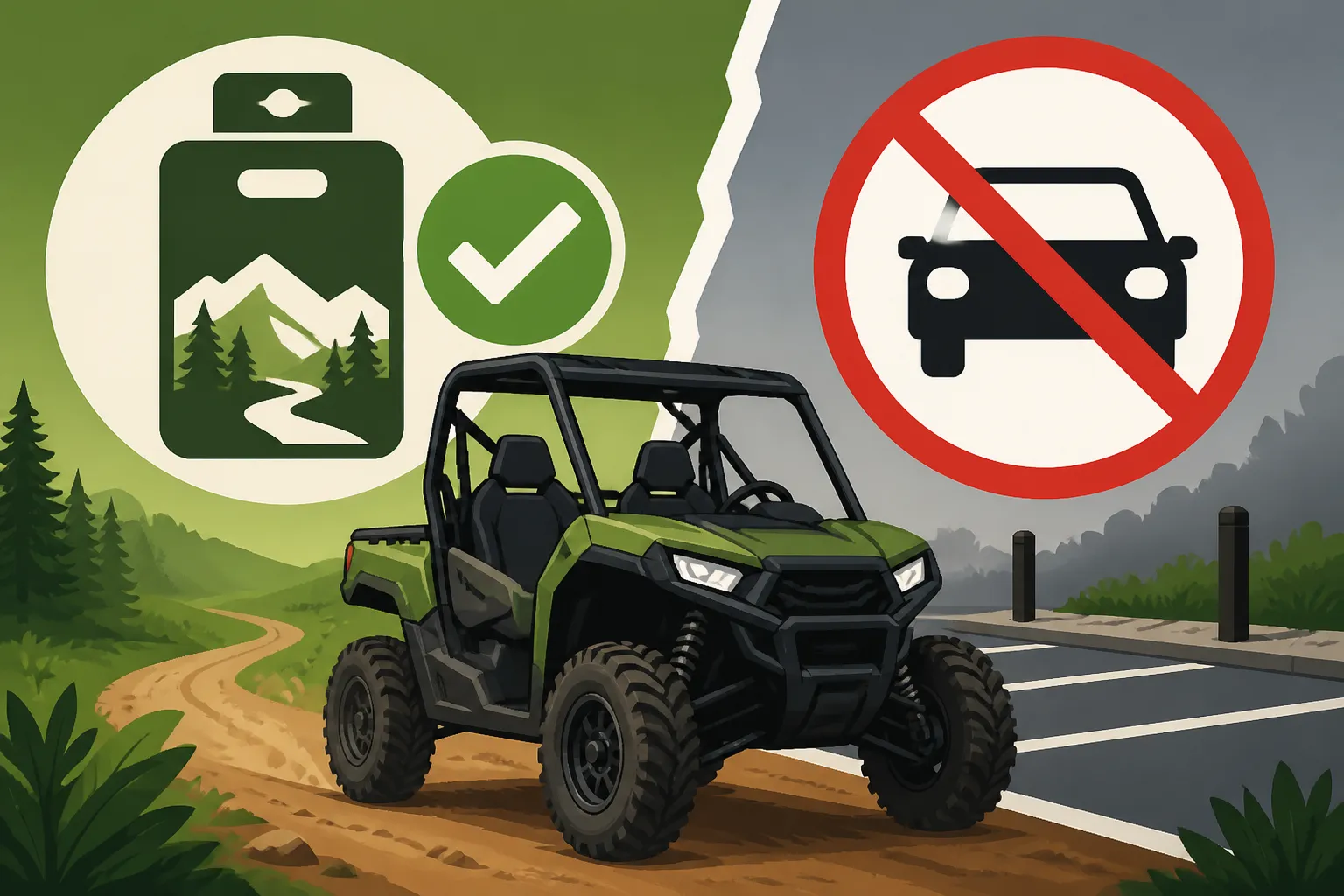
Why the Permit Does Not Cover Parking
An Oregon ATV permit can make your machine legal to operate where an OHV permit is required, but it does not automatically pay for the place you park or launch. That distinction catches riders off guard at staging areas. Here’s how operating permits, site fees and parking passes differ, and what to check before unloading.
What an Oregon ATV permit pays for
An Oregon ATV operating permit and a parking or day-use fee serve different purposes. The permit is tied to the off-highway machine and its legal operation under Oregon’s OHV rules. A site fee or parking pass is tied to access or parking at a particular recreation area.
In practical terms, think of the permit as permission for the machine to operate under the applicable OHV requirements, not as a pass to use every trailhead, staging area or parking lot. A valid permit does not necessarily open a closed route, authorize access across private land or cover fees charged by a site manager.
The permit requirement depends on the machine and where it will be ridden. Oregon classifies OHVs by features such as width, weight, seating and controls. If you are unsure which category applies, start with Which Oregon ATV Class Your Machine Falls Into. The operating permit itself is explained in [Oregon ATV Permits Explained].
A site fee, by contrast, may help pay for facilities and management at a specific location. Depending on the site, that can include parking, restrooms, access roads, signs or other day-use services. The fee may be collected by a federal land manager, a local authority, a private operator or another site manager. The same permit does not automatically replace those separate charges.
| Item | What it generally applies to | What it does not automatically cover |
|---|---|---|
| Oregon ATV operating permit | Operating a qualifying OHV under Oregon’s permit rules | Parking, a site’s day-use fee, camping or access to a closed area |
| Day-use fee | Use of a particular recreation site or staging area | The machine’s required operating permit |
| Parking or recreation pass | Access or parking at places covered by that pass | Every site in Oregon or the OHV permit requirement |
| Camping reservation or fee | An overnight campsite or related facility | Day-use parking elsewhere or permission to ride |
The important point is that these requirements can stack. A rider might need an operating permit for the machine, pay a day-use fee for a staging area, and separately pay for a campsite. Paying one does not prove that the other two have been handled.
The permit also does not guarantee that a location is open. Land managers can close routes or areas for safety, maintenance, wildlife protection, fire conditions or other reasons. Check current notices for the specific place you plan to ride. For more on the difference between the machine permit and other visitor charges, see Oregon Day Use Fees Separate From the Permit.
Why a staging area may charge separately
Parking and site fees are set according to the place you are visiting, not simply the type of OHV you own. A permit attached to a quad does not necessarily pay to maintain a dune staging lot, forest trailhead or recreation-site parking area. Those facilities may have their own costs and rules.
The responsible land manager matters. Public riding areas in Oregon can involve different agencies and landowners, and fee arrangements are not uniform across the state. A fee or pass that works at one location may not be accepted at another. Even nearby sites can have different rules if they are managed separately.
At an OHV area, the charge may be described as a day-use fee, parking fee, recreation pass or site fee. The wording and collection method vary. A fee might be collected at an entrance, through a payment station, online or through a pass system. Some locations may require a pass to be displayed in a vehicle, while others may use a different process. Read the instructions for that specific site rather than assuming the permit decal on your machine is enough.
This is particularly easy to mix up at Oregon’s coastal dune areas. Riders may need an OHV permit for the machine and also need to follow the day-use requirements at the staging area. The parking payment generally relates to the vehicle or visit, while the operating permit relates to the OHV. Check the current rules before leaving home; details can vary by site and may change. Paying the Day Use Fee at a Staging Area explains the site-fee question in more detail.
Forest recreation areas can have another pass system. A pass that covers certain federal recreation sites does not necessarily cover every place where an ATV or UTV can be ridden. Confirm that the pass is accepted at your exact parking location, and check whether the fee applies to the tow vehicle, the OHV, or both. The Northwest Forest Pass and Oregon Sites can help you understand why pass coverage is location-specific.
There may also be a parking charge at a privately operated facility, campground or business. In that case, the owner or operator sets the parking terms, subject to applicable rules. An Oregon OHV permit is not a general parking voucher for private property.
Access, parking and riding are separate questions
Before a trip, answer three different questions:
- May this machine be operated here? Check the Oregon OHV permit rules, machine class and any applicable out-of-state reciprocity rules.
- Is the route or area open to this machine today? Check current access restrictions, closures, signs and land-manager information.
- What does parking or site access cost? Check the fee and pass instructions for the exact staging area or recreation site.
These questions are related, but none answers the others. A machine can have a valid permit while its intended trail is closed. A trail may be open while the parking lot requires a separate fee. A parking pass may be valid while the machine still needs an Oregon permit.
This distinction is useful for visitors with an out-of-state machine, too. Reciprocity may affect whether an out-of-state permit is recognized for riding, but it does not automatically settle local parking fees. For the riding-permit side, see Oregon Permit Reciprocity List and Riding Oregon With an Out-of-State Permit. Then check the site’s own parking and day-use requirements.
How to check fees before you unload
A quick check before the trip is easier than trying to sort out a payment system while towing a trailer or standing at a busy entrance. Start with the exact destination, not just the general riding area. A region can have multiple staging locations with separate access points and fee instructions.
Use this simple planning process:
- Name the staging area or parking lot. “The Oregon Dunes” or “a forest trail” may not be specific enough. Identify the lot where you intend to unload.
- Check the manager’s current information. Look for fee, pass, payment and display instructions from the agency or operator responsible for that site.
- Confirm what the fee covers. Check whether it applies to day use, parking, a recreation pass or another service, and whether it covers the vehicle carrying the trailer.
- Check whether your pass is accepted there. Do not assume a pass valid at one recreation site works at another.
- Keep proof of payment available. Save a digital receipt or follow the site’s instructions for displaying a pass. Keep the OHV permit documentation separate from the parking proof.
- Recheck before departure. Closures, seasonal rules and payment instructions can change. A previous visit is not a guarantee that the same terms apply now.
For riders heading to the dunes, site-specific details may include where to pay and how to show proof. See Oregon Dunes Staging Areas From North to South when choosing a launch area, then verify the current fee rules for the lot you select. If comparing day-use payment with a pass, A Northwest Forest Pass Instead of the Day Fee addresses that distinction; the key is confirming coverage for your chosen site rather than assuming one option works everywhere.
Keep the operating permit and parking record in a way that makes them easy to produce. The permit decal belongs on the OHV according to the placement rules for its class. A day-use receipt or pass may need to be kept in the tow vehicle or displayed as directed. They are different records for different purposes. If the decal is hard to read or has come loose, address that separately; parking payment will not substitute for a required machine permit.
Common trip situations
You have an Oregon-permitted quad and are riding at a fee-based staging area. The machine permit addresses the OHV permit requirement. The staging area may still require a separate day-use payment or accepted pass. Check the lot’s instructions before unloading.
You drive a truck and trailer to a riding area. The parking charge may relate to the truck or site visit, rather than the ATV permit. Find out whether the fee is assessed per vehicle, per person or through another method. Do not assume that each OHV permit covers the tow vehicle’s parking.
You have an out-of-state permit or registration. First determine whether Oregon recognizes it for the riding you plan to do. Separately check the site fee. Permit reciprocity and parking-pass acceptance are not the same issue.
You are camping near the riding area. A campsite reservation or camping payment does not necessarily cover day-use parking at a separate staging area. Confirm the terms for both locations. A campground and a trailhead may be run by different operators.
You only stop briefly to unload or meet your group. Do not assume a short stop is exempt from a posted site fee. Follow the signs and payment directions at the entrance.
Avoiding confusion and unnecessary costs
The safest approach is to treat the permit, parking fee and camping charge as separate line items in your trip plan. That does not mean you will always pay all three. It means you check each one instead of assuming one payment covers the rest.
A few habits help prevent surprises:
- Save the name and location of the exact staging area, not just the broader riding destination.
- Check for posted signs when you arrive. Signs at the site can clarify payment, pass display and access restrictions.
- Do not rely only on advice from an old trip report or a previous visit. Fees and operating conditions can change.
- Keep the receipt or pass confirmation until you leave the site.
- If a payment machine or website is unavailable, follow the posted instructions. Do not assume that a technical problem cancels the fee.
- Ask the site operator or responsible agency if the fee description is unclear, especially when you have a larger rig, multiple machines or a group.
If you are not sure whether a particular pass covers the location, confirm before buying it or driving in. The site manager can tell you what is accepted and how it must be displayed. For broader background on how Oregon permit money is used, see Where Oregon Permit Fees Are Spent; that funding question is separate from whether a parking fee is due at the place you visit.
One final check is worth making: distinguish the machine’s permit decal from any vehicle pass. A decal is associated with the OHV and may be checked while you ride. A parking pass or receipt may be associated with the tow vehicle or site visit. Keep each where it can be shown for its intended purpose.
The practical takeaway is simple: an Oregon ATV permit is not a universal access or parking pass. Before a ride, confirm that the machine is properly permitted, the route is open, and the staging area’s payment requirements are met. That small check can prevent a frustrating stop before the ride even begins.
Disclaimer
This article is for general informational purposes only and does not constitute professional advice. Laws, prices and regulations vary by location and change over time. Consult a qualified professional for guidance on your specific situation.