How to Get an Oregon ATV Safety Card
Getting an Oregon ATV safety card is straightforward once you know which machine you’ll ride and which training requirement applies. The card is proof of safety education, not permission to ride every trail or a substitute for an operating permit. Here’s how to complete the right course, understand class-specific rules, and keep proof ready for a ride.
What the Oregon ATV safety card does
Oregon’s ATV safety card shows that a rider has completed an approved safety education requirement. It is tied to the rider, not the machine. If several people take turns operating one ATV, each operator may need to meet the applicable requirement.
The card is also different from an ATV operating permit. A safety card concerns the rider’s training; an operating permit concerns the machine’s authorization to use designated OHV areas. Depending on the machine and where you ride, you may need both. The Oregon ATV Safety Card Requirements explains the basic distinction and when the card applies.
Oregon’s requirements depend partly on the machine’s class. The main categories to check are Class I, Class III and Class IV. Class I generally includes quads and similar straddle-seat machines, while Class III covers off-road motorcycles. Class IV includes qualifying side-by-sides. If you are uncertain about your machine’s category, first review Which Oregon ATV Class Your Machine Falls Into.
| Machine class | Safety card consideration |
|---|---|
| Class I | Operators must meet Oregon’s safety education requirement, regardless of age. |
| Class III | Operators must meet Oregon’s safety education requirement, regardless of age. |
| Class IV | The card requirement is age-dependent; riders under 16 have a specific requirement. |
| Class II | Check the rules for the machine and use; do not assume Class I or Class IV rules apply. |
The table is a practical overview, not a substitute for checking the current rule for your machine and riding situation. Class labels can be confusing, especially for modified machines or vehicles that resemble more than one type. A steering wheel, seat arrangement and machine dimensions can matter. The Oregon’s Four ATV Classes Explained breaks down the categories.
A safety card does not replace an operating permit decal, a site pass, or permission to ride a particular road or trail. It also does not make a machine street legal. Before heading out, check the riding area’s requirements, closures and access rules as well as your rider-training status.
How to get an Oregon ATV safety card
For many riders, the simplest route is Oregon’s online safety education course. The course covers practical topics such as protective equipment, operating controls, riding behavior, terrain and how to avoid common hazards. It is designed to teach safe riding rather than simply issue a card after a form is submitted.
1. Check the requirement for your class and age
Start by confirming the machine’s class and who will operate it. This matters if a family shares a quad or side-by-side, or if a rider alternates between a dirt bike and another machine. A card or exemption that applies to one rider or class may not settle the requirement for another.
Oregon’s rules require safety education for Class I and Class III operators at every age. Class IV has a different age-based rule, so check the details if a young person will operate a side-by-side. The relevant explanation is Class I and Class III Card Rules in Oregon, along with Class IV Cards Only for Riders Under 16.
Do not use the machine owner’s card as proof for another operator. The card is individual. If a parent holds a card but a child is driving, the child’s own training status is what matters.
2. Take the approved course
Use the Oregon ATV safety education program or another course provider that Oregon recognizes. The online course is available without a course fee, though access methods and provider details can change. Confirm that you are using a course that qualifies for an Oregon card before spending time on training elsewhere.
Work through the material carefully rather than rushing to the final test. The course is useful for riders who have been operating for years, too. Familiarity with a machine does not necessarily mean a rider knows Oregon-specific safety expectations, youth supervision rules, or the risks of riding in unfamiliar terrain.
You may be able to take the course on a phone, but a larger screen can make diagrams and test questions easier to review. If you start on a mobile device, make sure your progress is saved and that you can access the completion record afterward. Taking the Course on a Phone covers practical considerations for completing the training on a mobile device.
3. Pass the course assessment
The online course includes an assessment. Oregon’s course pass mark is 80 percent. If you do not pass on the first attempt, review the material and follow the provider’s instructions for trying again. A failed attempt does not mean you cannot get a card; it means you need to demonstrate the required understanding.
Take enough time to read questions closely. Some test items turn on a safety detail that is easy to overlook if you skim. Focus on the reason behind each rule, not just the answer. That knowledge is more valuable when a rider faces a changing surface, crowded trail or unexpected obstacle.
4. Save or print your proof
After successful completion, follow the course provider’s instructions to access your card or completion record. Save a copy where you can find it, and consider printing one as a backup. A phone image or digital record may be convenient, but a device can lose power, get wet or have no service. Do not assume that an officer or riding-area attendant can look up your result for you.
Keep the proof associated with the rider, not tucked away with paperwork for the machine. A small waterproof sleeve in a riding pack can help protect a printed card. The card should be legible and readily available if someone asks to see it.
Age, hands-on training and other routes
The online course is not the only detail to consider, particularly for younger riders. Oregon has separate rules for age, supervision and practical training. A safety card does not override age restrictions or allow a young rider to operate a machine beyond their ability.
Riders under 16
Young riders should be checked against both the safety card rules and the rules governing minimum age and supervision. Requirements can vary by machine class, and children may need adult supervision even after completing classroom or online training. Review Oregon Rules for Riders Under 16 and Oregon Supervision Rules for Young Riders before deciding that a child is ready to ride.
Oregon also has a hands-on training requirement in some circumstances. Where it applies, completing the online course alone does not finish the requirement. Follow the current instructions for booking and completing practical training, and keep any proof of completion. The relevant details are outlined in Oregon Hands-On Training Requirements.
This is an important planning point for families. Do not wait until the day of a trip to check whether a child needs a practical session, whether an appointment is available, or whether the planned machine is appropriate for that rider. A successful online test is one part of readiness, not a blanket permission to operate any ATV.
Instructional permits and driver licenses
Some riders may qualify for an instructional permit or another route recognized by Oregon. An instructional permit has conditions and a limited period of validity. It is not the same as a completed safety card, and it should not be treated as an indefinite substitute. Check the current terms, including supervision and practical-training expectations, before riding under one.
A driver license may satisfy a safety-card requirement in certain situations, particularly in connection with particular machine classes. Do not assume that having a license automatically meets the requirement for every ATV class. Confirm the specific rule for the machine being operated. When an Oregon Driver’s License Replaces a Safety Card explains this distinction.
Riders with previous experience
Experienced riders may have an equivalency option, but riding experience by itself is not proof that Oregon recognizes a person’s training. If you have completed an accepted course elsewhere or have substantial riding experience, check whether an equivalency exam or another approved route is available. Follow the state’s current process rather than relying on a card from a course that may not qualify.
The Taking Oregon’s Equivalency Exam as an Experienced Rider explains the alternate path. If you are unsure whether a previous course counts, confirm before relying on it. It is easier to resolve a documentation question before a trip than during a stop at a trailhead.
Out-of-state cards and what to check before riding
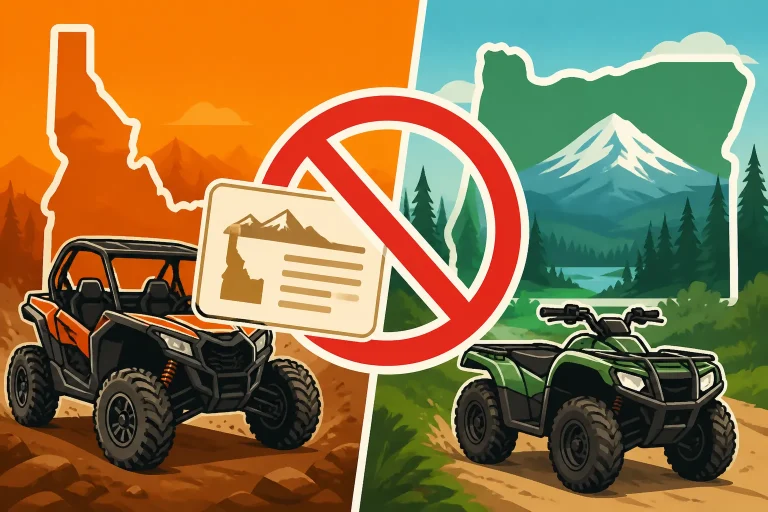
A visitor should not assume that a safety card issued elsewhere automatically meets Oregon’s requirements. Oregon has a specific reciprocity approach, and the safety-card reciprocity list is not necessarily identical to the list used for operating permits or registrations. In other words, a valid out-of-state permit decal does not automatically prove that the rider meets Oregon’s training rule.
Check the current recognized-state list and the conditions attached to it. If your card is not accepted, complete the Oregon course or use another route the state recognizes. The Does Oregon Accept an Out-of-State Safety Card? and Oregon Safety Card Reciprocity List pages address this issue.
Reciprocity questions matter for residents, too. Someone who moves to Oregon may have an out-of-state card that was valid where it was issued but may not satisfy Oregon’s rule. A person who plans to visit for an extended stay should also check how long any visitor exemption lasts and whether the clock applies to the rider, the machine or both.
Before riding, work through this checklist:
- Identify the ATV’s class, including any modifications that could affect classification.
- Confirm that the operator—not just the owner—has the required card, license or other accepted proof.
- Check age, supervision and hands-on training requirements for the rider.
- Verify that an out-of-state credential is recognized for safety-card purposes.
- Confirm the machine has any required Oregon operating permit, separate from the rider’s card.
- Check the site’s day-use fees, trail access, seasonal closures and local rules.
- Carry proof in a form that remains readable if your phone is unavailable or damaged.
A safety card is a useful foundation, but it is only one piece of preparation. The machine still needs to meet applicable permit rules, and the rider must use routes open to that type of ATV. For example, a safety card does not grant access to a closed road, private land or a trail restricted to a different vehicle class.
If your card is lost, damaged or inaccessible, use the course provider’s process to retrieve or replace the proof before your next ride. Keep a digital backup, but do not rely on a screenshot if the official card or record is available. For requirements that may have changed, verify the latest instructions with Oregon’s ATV safety education program before riding.
Disclaimer
This article is for general informational purposes only and does not constitute professional advice. Laws, prices and regulations vary by location and change over time. Consult a qualified professional for guidance on your specific situation.