Why Oregon’s ATV Safety Card Costs Nothing
Oregon’s ATV Safety Education Card is free, but riders can still run into confusing rules about who needs it, what training counts, and whether the card is the same as an ATV permit. The key is to separate the safety requirement from machine permits and license rules. Here’s what the free card covers, who needs one, and what may still take time or cost money.
What Oregon’s free safety card covers
Oregon requires safety education for people operating ATVs on public land, and the Oregon Parks and Recreation Department provides an official online course and initial ATV Safety Education Card at no charge. The free offer applies to the official course and initial card, not every class or service that might appear in search results.
That distinction matters because a rider may encounter third-party vendors offering alternative courses. The Oregon Parks and Recreation Department cautions that those vendors may charge fees. If a course advertises a price, check whether it is the official Oregon course before paying. You can also review How to Get an Oregon ATV Safety Card and Oregon ATV Safety Card Cost before enrolling.
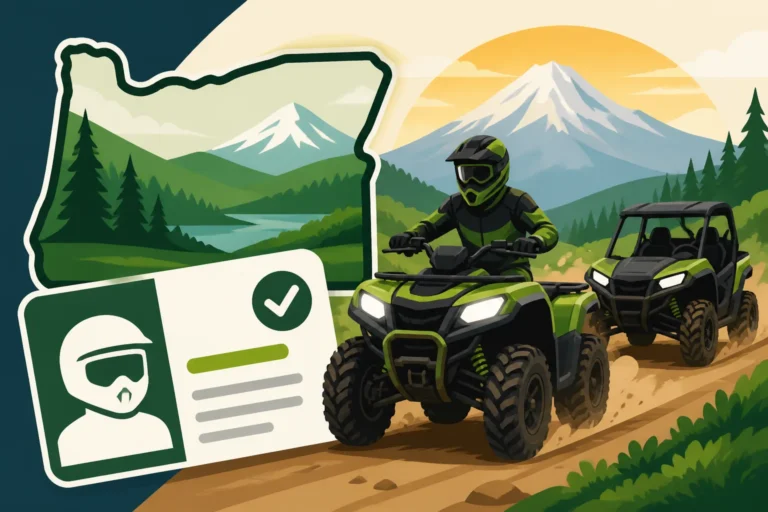
The card is proof of safety education. It is not the same thing as permission to ride a machine on land open to ATV use. According to the Oregon Parks and Recreation Department, riders need an ATV Operating Permit for machines operated on lands open to ATV use. That permit is separate from the safety course and card; Oregon ATV Operating Permit explains how the two requirements differ.
| What you need | What it does | Cost or rule |
|---|---|---|
| ATV Safety Education Card | Shows that the rider has completed required safety education for applicable vehicle classes | The official online course and initial card are free, according to the Oregon Parks and Recreation Department |
| ATV Operating Permit | Authorizes a machine to operate on lands open to ATV use | The Oregon Parks and Recreation Department lists the permit at $10, valid for two years, as of November 2026 |
| Replacement safety card | Replaces a card that has been lost or damaged | The Oregon Parks and Recreation Department lists a replacement-card fee of $8 as of November 2026 |
The permit and card answer different questions. The card concerns the rider’s safety education; the operating permit concerns the machine’s use on eligible land. A rider can complete the course without thereby obtaining a machine permit. Likewise, buying a machine permit does not automatically satisfy a rider’s education requirement.
The Oregon Parks and Recreation Department issues ATV permits. The Oregon Department of Transportation explains that the DMV does not register ATVs, even though an ATV may be titled with the DMV. This is another reason to keep the paperwork categories clear: a title, an operating permit, and a safety card are not interchangeable documents.
Why make the official safety course free? The practical effect is straightforward: a rider can complete the required learning without the initial card itself becoming a financial barrier. That does not mean every related expense disappears. A replacement card can carry a fee, some outside course providers may charge, and the machine may still need its own operating permit.
Who needs the card, and which course rules apply
The card requirement depends on the ATV class, not simply on whether someone is an adult or a child. Oregon recognizes four ATV classes, defined by Oregon law, according to the Oregon Department of Transportation. The Oregon Parks and Recreation Department says an ATV Safety Education Card is required for all ages operating Class I and Class III vehicles.
Class I includes vehicles such as quads and three-wheelers. Class III covers off-road motorcycles. In other words, adults are not automatically exempt from the card requirement when riding these classes. The Oregon Parks and Recreation Department says riders aged 16 or older on a Class I quad or Class III off-road motorcycle must possess a card, and its general rule requires the card for all ages in those classes. See Oregon ATV Safety Card Requirements for a class-by-class overview.
Young riders have additional steps. According to the Oregon Parks and Recreation Department, youth under age 16 operating Class I or Class III ATVs must complete the online course and a hands-on training or evaluation course. The department also says youth under 16 must complete the hands-on course within six months of the online course. The online course is therefore not the whole process for these young riders.
After completing the online course, a youth under age 16 receives an Instructional Permit that is valid for 180 days, according to the Oregon Parks and Recreation Department. It allows the young rider to gain experience under supervision while meeting the relevant requirements; it should not be mistaken for a blanket exemption from the training rules. For details on the in-person portion, see Oregon Hands-On Training Requirements.
Supervision is also part of the rules. The Oregon Parks and Recreation Department requires adult supervision for youth operators under age 16. By law, the supervisor must be at least 18 years old and hold a valid ATV Safety Education Card. The department says the supervisor must be able to provide immediate direction and assistance, so simply being somewhere nearby may not meet the practical purpose of the rule.
The rules are different for other classes:
- For Class II vehicles such as sand rails, trucks, and SUVs, the Oregon Parks and Recreation Department requires a valid state-issued driver license or Instruction Driver Permit. A safety card is not the substitute for this driving-privilege requirement.
- For Class IV side-by-sides, operators need a valid driver license or permit, or an ATV Safety Education Card if under 16, according to the Oregon Parks and Recreation Department. The department also says operators under 16 must meet the manufacturer’s age recommendations.
- For Class III off-road motorcycles, the Oregon Parks and Recreation Department sets a minimum operator age of seven years and requires the safety card for all riders. Youth training and supervision rules still apply where relevant.
These differences can be easy to miss when a household has more than one kind of machine. A card required for a quad does not replace a license or permit requirement for a Class II vehicle. Similarly, classifying a side-by-side correctly is important before deciding which proof a particular operator needs. The class definitions are set by Oregon law, as the Oregon Department of Transportation explains; Which Oregon ATV Class Your Machine Falls Into can help with that first step.
Free does not mean automatic or universal
The official course and initial card are free, but riders still have to complete the required steps and carry or produce the correct proof. “Free” describes the cost of the official course and initial card; it does not mean that a rider can skip training, that every vehicle class uses the same card rule, or that the machine needs no separate permit.
For a Class I quad or Class III motorcycle, the Oregon Parks and Recreation Department requires the ATV Safety Education Card for all ages. That remains true even for a rider who has considerable experience. The course requirement is tied to the class and Oregon’s public-land operating rules, not simply to whether a person believes they already know how to ride.
For youth under 16 on Class I or Class III vehicles, plan for both the online course and hands-on training. Do not assume that finishing the online portion means all requirements are complete. The Oregon Parks and Recreation Department says the hands-on course must be completed within six months, and the young rider must also follow supervision rules. Oregon Rules for Riders Under 16 covers related youth requirements.
Nonresidents also need to check the rules before riding. According to the Oregon Parks and Recreation Department, nonresidents operating Class I and Class III vehicles in Oregon must take the online ATV Safety Course and carry an ATV Safety Education Card unless exempt. A card or permit from another state does not automatically settle every Oregon requirement. Oregon has permit reciprocity with 18 states, according to the department, but permit reciprocity and safety-card acceptance are separate issues. Check Does Oregon Accept an Out-of-State Safety Card? and Oregon Permit Reciprocity List rather than treating one as proof of the other.
There can also be a charge if a card must be replaced. The Oregon Parks and Recreation Department lists the replacement-card fee as $8 as of November 2026. Keep the card somewhere it can be found when needed, and consider saving a copy of the completion information. A copy may help with personal records, but riders should confirm which form of proof is accepted for their situation rather than assuming a stored image replaces the required card.
Finally, distinguish the safety card from an operating permit whenever you prepare for a ride. The Oregon Parks and Recreation Department says the operating permit is required for a machine on lands open to ATV use. It is issued for the vehicle, while safety education applies to the operator. Before heading to a riding area, check both the rider’s documentation and the machine’s permit status.
A practical checklist before you ride
Use this checklist to avoid paying for the wrong course or arriving with only part of the required paperwork:
- Identify the ATV class first. Oregon’s class definitions are based on the vehicle, not the rider’s preferred name for it. The Oregon Department of Transportation identifies the four classes in Oregon law.
- Check the operator rule for that class. Class I and Class III riders need the safety card at every age, according to the Oregon Parks and Recreation Department. Class II operators need driving privileges, while Class IV requirements vary by age and operator credentials.
- Use the official free online course when you need Oregon’s initial safety card. If a provider asks for payment, confirm whether it is an outside alternative rather than the official course.
- If the rider is under 16 and operating Class I or Class III, plan for the hands-on course as well as the online course. The Oregon Parks and Recreation Department requires both and sets a six-month completion window.
- Arrange qualified supervision for a youth operator under 16. The Oregon Parks and Recreation Department says the supervisor must be at least 18 and hold a valid ATV Safety Education Card.
- Check whether the machine needs an ATV Operating Permit for the land you plan to ride. A completed safety course does not issue that machine permit.
- If visiting from another state, check both Oregon’s safety-card rule and any applicable permit reciprocity. They are separate questions.
- Keep track of the card after completion. If it is lost or damaged, the Oregon Parks and Recreation Department lists a replacement fee, so replacement is not the same as obtaining the initial card.
The free card is useful because the required safety education and initial proof do not have a course charge through Oregon’s official program. The trade-off is that riders still need to follow the steps that apply to their class and age, and the card does not remove separate permit or license obligations. If you sort out the vehicle class first, then check the operator’s training and documents, the process is much easier to manage.
Sources
- Oregon Parks and Recreation Department — Oregon Parks and Recreation : ATV Permits : Ride ATVs : State of Oregon (checked November 3, 2026)
- Oregon Parks and Recreation Department — Oregon Parks and Recreation : ATV Permits : Ride ATVs : State of Oregon (checked November 3, 2026)
- Oregon Parks and Recreation Department — Oregon Parks and Recreation : ATV Safety Card : Ride ATVs : State of Oregon (checked November 3, 2026)
- Oregon Parks and Recreation Department — Oregon Parks and Recreation : ATV Safety Card : Ride ATVs : State of Oregon (checked November 3, 2026)
- Oregon Parks and Recreation Department — Oregon Parks and Recreation : Places to Ride : Ride ATVs : State of Oregon (checked November 3, 2026)
- Oregon Parks and Recreation Department — Oregon Parks and Recreation : Places to Ride : Ride ATVs : State of Oregon (checked November 3, 2026)
- Oregon Parks and Recreation Department — Oregon Parks and Recreation : ATV Permits : Ride ATVs : State of Oregon (checked November 3, 2026)
- DEPARTMENT OF TRANSPORTATION DRIVER AND MOTOR VEHICLE SERVICES — 463.pdf (checked November 3, 2026)
- Oregon Parks and Recreation Department — Oregon Parks and Recreation : ATV Safety Card : Ride ATVs : State of Oregon (checked November 3, 2026)
- Oregon Parks and Recreation — Oregon Parks and Recreation : Youth Riders : Ride ATVs : State of Oregon (checked November 3, 2026)
- Oregon Parks and Recreation Department — Oregon Parks and Recreation : Types of ATVs : Ride ATVs : State of Oregon (checked November 3, 2026)
- Oregon Parks and Recreation Department — Oregon Parks and Recreation : Need to Know : Ride ATVs : State of Oregon (checked November 3, 2026)
- Oregon Parks and Recreation Department — Oregon Parks and Recreation : FAQ : Ride ATVs : State of Oregon (checked November 3, 2026)
Disclaimer
This article is for general informational purposes only and does not constitute professional advice. Laws, prices and regulations vary by location and change over time. Consult a qualified professional for guidance on your specific situation.