When an Oregon Driver’s License Replaces a Safety Card
A driver’s license can spare some Oregon ATV riders from carrying a separate safety card, but it does not replace every permit or rule that applies to a ride. The key is knowing which machine class you’re operating, whether the license is valid, and what you still need to show at a trailhead or roadside stop. Here’s how to tell what your license covers—and what it doesn’t.
When a driver’s license can stand in for an Oregon ATV safety card
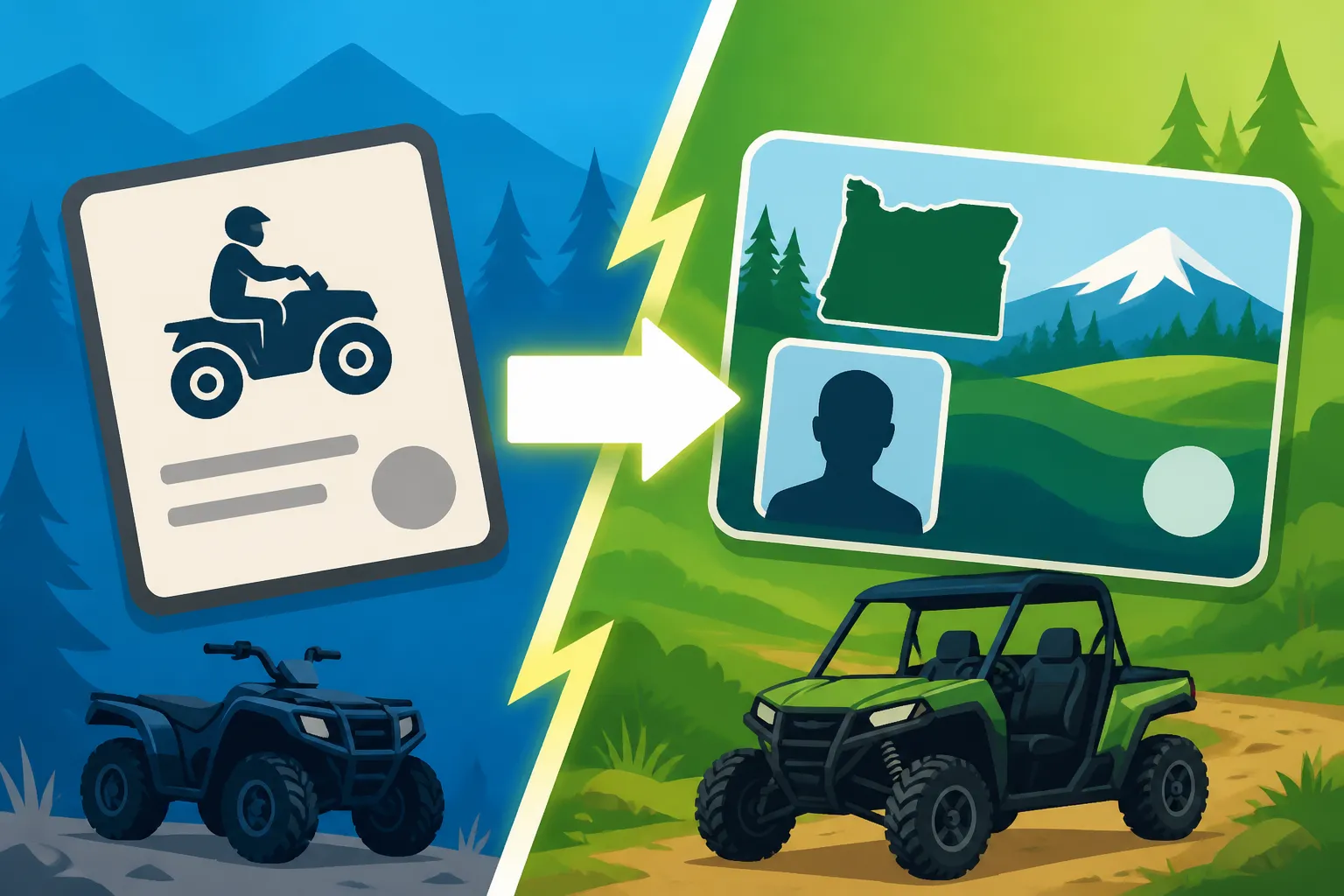
Oregon’s ATV safety-card rules depend on the type of machine and, for some riders, age. For operators who are required to have an ATV safety education card, a valid driver’s license can be accepted in its place. That means an eligible rider may not need to complete the separate ATV course just to satisfy the safety-card requirement.
The substitution is about the safety card only. A driver’s license does not automatically provide an ATV operating permit, authorize you to ride a closed route, or make an off-road machine street legal. It also does not remove age-based supervision rules or other requirements that apply to your machine.
The class of your ATV or UTV matters. Oregon uses four ATV classes, with differences such as width, seating, steering controls and how the machine is ridden. A quad and a side-by-side may have different card requirements, even if the same person operates both. If you are unsure how your machine is classified, start with Which Oregon ATV Class Your Machine Falls Into.
| Situation | What the driver’s license may do | What it does not do |
|---|---|---|
| You operate a class that requires an ATV safety card | A valid driver’s license can be accepted instead of the separate card where the exemption applies | It does not replace the operating permit or vehicle decal |
| You operate a class with no card requirement for your age or situation | You may not need either document to satisfy the card rule | You still need to follow all other riding rules |
| You ride a Class II machine on roads | A driver’s license is part of the road-use requirements | It does not turn a non-street-legal class into a plated vehicle |
| You have an expired, suspended or otherwise invalid license | It may not qualify for the substitution | Do not assume an expired license or learner document is enough |
| You carry an out-of-state license | It may qualify if it is valid and recognized for the purpose | It does not automatically establish permit or safety-card reciprocity |
For the broader class-by-class rules, see Oregon ATV Safety Card Requirements. The practical takeaway is to check the card rule for the machine you are actually taking out, rather than relying on a general assumption that “a driver’s license covers ATVs.”
The license must be valid
Treat “valid driver’s license” as a real condition, not a formality. An expired license, a suspended license, or a document that only allows supervised driving may not qualify as a substitute. If your status is unusual, check Oregon’s current official guidance before riding rather than waiting for a ranger or officer to decide roadside.
A license from another state can be relevant, too. Being a visitor does not by itself mean you need an Oregon driver’s license to use the substitution. But a driver’s license and an out-of-state ATV safety card are different documents, and Oregon’s rules for recognizing them may not be identical. If you plan to rely on an out-of-state safety card instead, review Oregon Safety Card Reciprocity List.
Not every rider needs a card in the first place
The license exemption can be easy to misunderstand because the underlying card rule is not the same for every class and rider. Some operators are covered by a card requirement based on the class of machine; some class IV rules are age-specific. An adult operating a machine that does not require a card in that situation does not need to obtain a card simply to replace it with a license.
For details specific to adults, see Oregon ATV Safety Card for Adults. For class IV, the age distinction is covered in Class IV Cards Only for Riders Under 16. If a young rider is involved, use Oregon ATV Safety Card for Children and Oregon Rules for Riders Under 16 as well. A parent’s license does not substitute for a child’s card or change the child’s riding and supervision requirements.
What a driver’s license does not replace
The biggest practical mistake is treating one document as a complete pass to ride. Oregon has separate requirements that serve different purposes. A safety card or qualifying license relates to operator education. An ATV operating permit relates to the machine’s authorization to operate in Oregon’s covered riding areas. A road-use registration, plate, insurance policy, or access permission is another matter again.
The operating permit and decal
A driver’s license does not replace the Oregon ATV operating permit or its decal. If your machine needs an Oregon permit, you still need to obtain it and place the decal as directed. The permit question is separate from whether you have a safety card or driver’s license. See Oregon’s ATV Operating Permit for the basic distinction, and Oregon ATV Permit Decal Placement for where the decal belongs.
This is particularly easy to miss when you have just bought a machine, borrowed one, or brought it from another state. A license may satisfy an operator-card requirement, but it does not establish that the machine has the correct Oregon permit or qualifies under a reciprocity rule. Visitors can check Oregon Permit Reciprocity List and Riding Oregon With an Out-of-State Permit before assuming an existing sticker is enough.
Road legality and Class II requirements
A driver’s license does not make a quad, dirt bike or side-by-side street legal. Oregon’s ATV classes are not interchangeable, and a machine that is permitted for off-road use does not automatically qualify for plates or public-road travel. Class II machines have a distinct road-use pathway, but that does not mean all UTVs or ATVs can be plated. Learn the difference in Class II Machines That Can Be Plated in Oregon and Oregon Street Legal UTV Requirements.
For a Class II machine used on public roads, the license is part of a wider set of requirements. Registration, insurance, equipment and route rules may apply. Having a driver’s license is not a substitute for those requirements, just as a safety card is not a substitute for the license needed to drive a road-authorized vehicle.
Site fees, closures and access rules
Neither a safety card nor a driver’s license gives you permission to ride on every parcel of land or every trail. A staging site may have its own day-use fee, pass or parking requirement. Public-land routes can be closed seasonally, during fire restrictions, for habitat protection, or because of active work. Private land requires the owner’s permission.
Before a trip, check the rules for the specific riding area and route. An operator who has the right license, card status and machine permit can still be riding illegally if they cross a closure or use a road that is not open to ATVs. For general safety-card and access distinctions, Oregon’s ATV Safety Education Card and Oregon Day Use Fees Explained are useful starting points.
How to decide what to carry on a ride
You do not necessarily need to carry both a driver’s license and an ATV safety card if the valid license is accepted as your card alternative. Still, carrying the documents that apply to your ride can make a stop simpler. The right choice depends on your machine class, your age, your license status, and whether you are visiting Oregon with out-of-state paperwork.
Use this process before you leave:
- Identify the machine class. Check the machine’s width, seating, controls and configuration. Do not identify it by its marketing name alone. A model name that sounds like “UTV” does not settle its Oregon class.
- Check whether your class and age require a safety card. Use the current official class-specific guidance. Remember that class IV rules can differ by age, while classes I and III have their own card requirements.
- Confirm that your driver’s license is valid. If it is expired, suspended, restricted or a learner document, do not rely on it as an exemption without checking.
- Confirm the machine’s permit status. A valid license does not prove the machine has the required permit or that an out-of-state permit is recognized.
- Check the riding area. Look for current closures, access rules and any day-use fee or pass requirement.
- Carry useful proof. Keep your license accessible and have permit or registration information available as applicable. If you use a phone for documents, make sure you can access them without a signal.
For a rider who is unsure about the safety-card requirement, completing the card course can be a straightforward way to avoid relying on an exemption. The card is purpose-built evidence that the operator completed the required education, while a license is an alternative only when the rule recognizes it. How to Get an Oregon ATV Safety Card explains the course route, and The Free Oregon Safety Card Online covers the online option.
Keep documents protected and easy to reach
Damp weather, dust and sand can make paper documents hard to read. A small waterproof document pouch can help keep a license or printed information protected. Riders often compare simple sleeves and pouches on Amazon, but the important features are a secure closure, a size that fits the documents without folding them, and a place where you can reach them without unpacking your whole machine.
If you store a card or paper in a toolbox, make sure it stays dry and does not become buried beneath tools and recovery gear. Some riders use a zippered pouch; others keep documents with their phone in a waterproof case. Amazon is one place to find these basic storage options, but whatever you choose should be secure enough not to blow away or fall out on the trail.
A phone can be a useful backup, but do not make your only proof depend on a strong cell signal. If you keep a digital copy, save it for offline access and protect the device from water and impact. A phone image is not necessarily a substitute for an original document if an official rule requires the actual credential, so confirm what is accepted. For practical phone display guidance, see Showing an Oregon Safety Card on Your Phone.
Common situations that cause confusion
“I have a license, so I don’t need any ATV paperwork”
The license may address the safety-card requirement where the exemption applies. It does not satisfy the machine permit requirement. It also does not prove that the vehicle is properly registered for road use or that you have permission to ride a particular route.
Think of the documents as answering different questions:
- Driver’s license or safety card: Are you covered by the operator-education requirement?
- ATV permit and decal: Is the machine permitted for the relevant off-highway use?
- Registration, plates and insurance: Is the machine authorized and equipped for the type of road use you intend?
- Site pass or day-use payment: Have you met the access requirements for that location?
- Route map, signs and land rules: Is this specific road or trail open to your machine?
You may need only some of these, but one does not automatically stand in for the others.
“My child can use my license as the substitute”
A parent or guardian’s license does not cover a child operating an ATV. The relevant document or exemption must apply to the person actually operating the machine. Children have separate requirements based on age and machine class, and they may also need to meet supervision or training conditions. Check Oregon ATV Safety Card for Children before taking a young rider out.
A child riding as a passenger is a different situation from a child operating the machine. Do not assume a passenger’s age requirements or a parent’s credentials settle the rules for a young operator. The machine’s design, the child’s age and the type of use all matter.
“My motorcycle endorsement or ordinary license covers everything”
A driver’s license may be accepted in place of a safety card where Oregon allows that substitution, but that does not necessarily mean every endorsement or license condition applies in the same way to every ATV class. Nor does it remove equipment and operating rules. Check the requirements for the specific machine rather than extending one rule to all off-highway vehicles.
If you are operating a Class III off-road motorcycle, for example, consult Class I and Class III Card Rules in Oregon. A general license may address the card requirement, but it does not eliminate requirements concerning permits, helmets, sound, spark arresters or trail access.
“My out-of-state card and permit are the same kind of reciprocity”
They are not. Oregon may treat safety education credentials and machine permits under separate reciprocity rules. A safety card recognized for operator education does not automatically mean an out-of-state sticker is accepted as the Oregon operating permit, and an accepted permit does not necessarily prove that the operator has met Oregon’s card rule.
If you ride in Oregon temporarily, check both sides of the question: what credential is accepted for the operator, and what permit or registration is accepted for the machine. Does Oregon Accept an Out-of-State Safety Card? covers the first issue; Riding Oregon With an Out-of-State Permit covers the second.
“I bought a card, so I can leave my license at home”
A safety card and a driver’s license are not always interchangeable in both directions. A safety card shows that you completed ATV education; it is not a general driver’s license and does not authorize road driving. If you plan to operate a Class II machine on public roads, follow the separate license and vehicle requirements for that use.
For an off-road ride, decide which document applies and carry the one you rely on. If you have both, carrying both can reduce confusion, especially when you are riding multiple machine classes or travelling with a group whose machines have different requirements.
A simple pre-ride check
Before loading up, run through this short check:
- Machine: Have you identified the correct Oregon ATV class?
- Operator: Does the card rule apply to this rider, and is a valid driver’s license an accepted alternative in this situation?
- Permit: Does the machine have the required Oregon permit or a permit recognized under the applicable reciprocity rule?
- Location: Are the route, trail and staging area open to your machine today?
- Extra costs or permissions: Does the site require a separate day-use payment, parking pass or landowner permission?
- Documents: Can you quickly show the license, permit information and any other proof you are relying on?
When a valid driver’s license replaces the safety card, it solves one narrow problem: documenting that the operator meets the applicable card requirement. It does not replace the machine’s permit, make a vehicle street legal, open a closed trail or cover a young rider. Checking each requirement separately is a little more work before the trip, but it is much easier than sorting out a mismatch at the trailhead.
If you want a physical backup for paperwork, a compact document organizer can keep a card, permit details and emergency contacts together. Amazon listings may offer organizers made for outdoor use, but look for a secure closure and materials that tolerate water and grit rather than choosing by appearance alone. Keep essential documents accessible, not loose in a cargo area where they can get wet or damaged.
Disclaimer
This article is for general informational purposes only and does not constitute professional advice. Laws, prices and regulations vary by location and change over time. Consult a qualified professional for guidance on your specific situation.