Two Lists That Do Not Match in Oregon
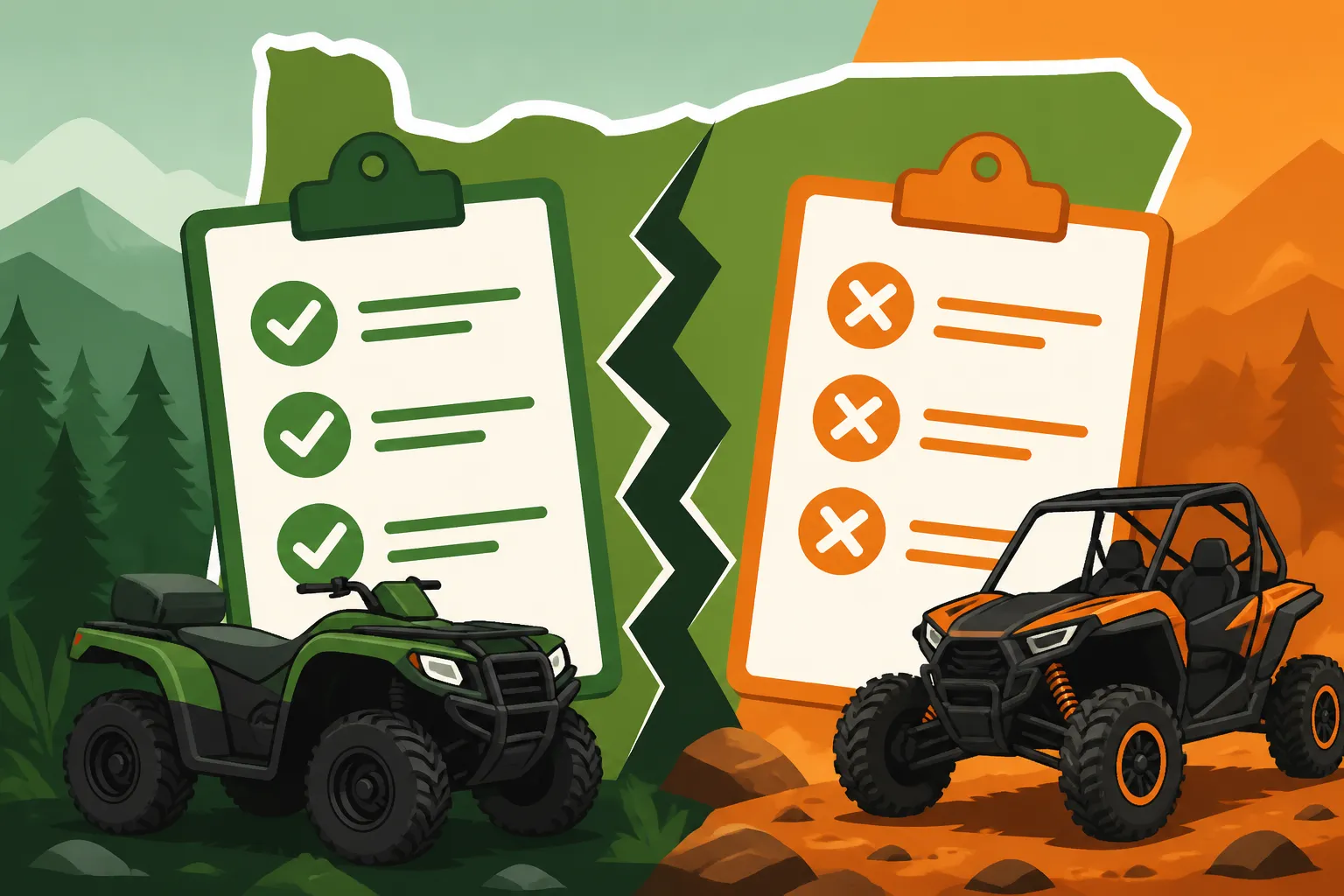
Oregon has separate reciprocity rules for an out-of-state machine’s operating permit and its rider’s safety card. The two lists do not match, so a sticker accepted for a visit does not automatically satisfy the rider requirement. Here’s how to tell which rule applies, what to check before riding, and when you may need an Oregon permit or card.
Why Oregon has two reciprocity lists
When you bring an ATV or UTV from another state, Oregon may consider two different things: whether the machine has an accepted operating permit or registration, and whether the person riding it has an accepted safety credential. These are separate requirements, with separate rules and separate reciprocity lists.
The permit is tied to the machine. Depending on the state and the document it issues, it may take the form of an off-highway vehicle permit, registration, decal, or similar authorization. Oregon’s permit reciprocity rules determine whether a qualifying out-of-state credential can stand in for an Oregon ATV operating permit for a visiting machine.
The safety card is tied to the rider. It shows that the person has met a safety education requirement recognized for the relevant kind of riding. Oregon’s safety-card reciprocity rules determine whether a card issued elsewhere can satisfy Oregon’s rider education requirement.
Oregon maintains an Oregon Permit Reciprocity List and an Oregon Safety Card Reciprocity List. One covers machine credentials; the other covers rider credentials. Oregon’s permit list includes 18 states, while the safety-card list includes 13. Those totals are a useful reminder that the lists have different membership, not a reason to assume a state on one list is also on the other.
| What you are checking | The credential belongs to | What reciprocity can address | What it does not establish by itself |
|---|---|---|---|
| Permit or registration | The machine | Whether an accepted out-of-state credential can satisfy Oregon’s operating-permit requirement | Whether the rider has the required safety card, or whether the machine can ride a particular route |
| Safety card | The rider | Whether an out-of-state education credential can satisfy Oregon’s safety-card requirement | Whether the machine has an accepted permit, or whether it is allowed on a specific trail |
| Oregon operating permit | The machine | Oregon’s permit requirement when reciprocity does not apply | Road access, land access, or compliance with other riding rules |
| Oregon safety card | The rider | Oregon’s education requirement when an out-of-state card is not accepted | Permission for a machine to operate without the required permit |
Think of the two checks as independent. A rider may have an accepted card while the machine still needs an Oregon permit. Conversely, the machine may qualify for permit reciprocity while the rider still needs an accepted safety credential.
This distinction matters even if you have ridden legally at home for years. A state may issue a registration that Oregon accepts for a limited visit, but that state’s safety card might not be recognized. Another state’s course card might be accepted even though its machine decal does not qualify under Oregon’s permit rules. The document names can sound similar, but the rules answer different questions.
For an overview of the rider requirement itself, see Oregon ATV Safety Card Requirements. For a broader explanation of the machine credential, see [Oregon ATV Permits Explained].
Why the lists do not match
Reciprocity is not one universal agreement between states. Oregon evaluates different credentials for different purposes. An out-of-state permit or registration is evidence that a machine has met another jurisdiction’s operating requirement. A safety card is evidence that a rider has completed an education process Oregon recognizes. Those documents are created under different laws and may be issued by different agencies.
As a result, a state can meet Oregon’s criteria for one kind of credential without meeting the criteria for the other. The states do not need to use identical program names, designs, or procedures, but the underlying requirements still matter. A state’s machine decal does not prove that its safety course meets Oregon’s standards, and a course card does not prove that the state’s machine permit is reciprocal.
The differences can also reflect how each state organizes its off-highway vehicle program. A state might require registration but have no safety card program that Oregon accepts. Another might have a recognized safety course but issue a machine credential that does not qualify for Oregon reciprocity. Similar-sounding terms such as “registration,” “permit,” “sticker,” and “education card” are not interchangeable.
This is why checking a state’s name once is not enough. Check the appropriate Oregon list for each credential:
- Find the machine’s home state on the permit reciprocity list.
- Confirm that the machine has the specific type of valid credential Oregon recognizes.
- Find the rider’s card-issuing state on the safety-card reciprocity list.
- Confirm that the rider’s card is current and applies to the rider and machine class.
- Check any time limit, age rule, class-specific rule, and riding-area requirement that may apply.
Do not infer reciprocity from a neighbor’s experience, an online discussion, or a dealer’s description alone. The person you spoke with may have a different state’s registration, a different kind of card, or a different riding situation. They may also have visited during a period when a particular exception applied.
The lists can change, too. Before a trip, verify the official Oregon information for both credentials. If the state is not listed, if the credential type is unclear, or if the list does not address your situation, ask the responsible Oregon program or the land manager before you head out. It is safer to resolve the question ahead of time than to discover at a staging area that you have only one of the documents you need.
A useful example: Washington and Idaho
Washington and Idaho are useful examples of why the two lists must be read separately. Oregon has specific explanations about Washington’s absence from a reciprocity list and Idaho’s absence from the permit list. At the same time, Oregon recognizes an Idaho safety card under its safety-card rules. That difference illustrates the central point: recognition of a state’s rider card does not automatically mean recognition of its machine permit.
If you ride an Idaho machine with an Idaho card, check the Idaho card’s status against Oregon’s safety-card rules, then separately check whether the machine’s permit or registration qualifies. If you ride a Washington machine, do not assume its home-state document is accepted simply because the machine is properly permitted in Washington. Review Oregon’s current permit reciprocity information and the applicable safety-card list independently.
The relevant explanations include Why Washington Is Not on Oregon’s List, Why Idaho Is Not on Oregon’s List, and Why Oregon Accepts an Idaho Safety Card. Read the explanation that matches the document you actually have, not just the state where you live.
How permit reciprocity works for a visiting machine
The permit reciprocity question is: does Oregon accept the machine’s out-of-state credential for the ride you plan to take? Start by identifying exactly what the machine carries. A registration card, plate, permit, or decal may each have a different role in the home state. Do not rely on the casual name used by a seller or another rider.
Next, check Oregon’s permit reciprocity list and its conditions. Inclusion of a state does not necessarily mean every credential that state issues qualifies, or that reciprocity lasts indefinitely. The machine may need to be properly registered or permitted at home, and Oregon may limit how long an out-of-state machine can rely on reciprocity. Oregon’s rules include a time cap for some out-of-state permit reciprocity; confirm the current limit and how it applies before an extended stay. See Oregon’s Sixty-Day Cap on Reciprocity and Riding Oregon With an Out-of-State Permit.
If your home-state credential qualifies and your visit falls within the applicable rules, you may not need to buy an Oregon permit for that period. But that does not waive other requirements. You still need to obey the trail or land manager’s access rules, use the machine only where its class is allowed, and meet any applicable sound, equipment, or operating rules. Permit reciprocity is not a general pass to ride anywhere in Oregon.
If your state or credential does not qualify, or your planned stay exceeds the applicable reciprocity period, check whether an Oregon operating permit is required. Visitors should not assume their home-state registration substitutes for Oregon authorization. The practical alternative may be to obtain an Oregon permit before riding, subject to the current rules for the machine and purchase method. For visitor-specific details, see Oregon ATV Permit for a Nonresident and Oregon Rules for a Visiting Rider.
Keep proof of the machine’s home-state credential with you. A decal alone may not answer every question about the machine’s status, and a document stored at home is not useful if an officer or ranger asks to see it. Carry the registration or permit document in a protected place, and make sure it is legible and matches the vehicle identification information on the machine.
A few common situations call for extra care:
- You recently moved to Oregon. A rule intended for temporary visitors may not apply the same way after you establish residence. Check the requirements for a person who has moved, rather than relying on visitor reciprocity.
- You bought the machine out of state. The seller’s paperwork may not show that the credential is valid or transferable. Confirm the machine’s current status and Oregon requirements before riding.
- The decal is old or hard to read. A faded sticker is not a substitute for a valid permit. Keep supporting documents and ask the issuing authority about replacement or renewal.
- You are riding a rental or borrowed machine. Confirm who is responsible for the permit and what document the machine carries. Do not assume that another person’s registration or rental agreement resolves every Oregon requirement.
- You plan a long stay or repeated visits. A credential that works for a short visit may stop qualifying once a time limit applies. Check the rule before the first ride, not after several weeks of riding.
The permit rule is also not the same as titling. Oregon’s ATV operating permit and ownership paperwork serve different purposes. A title can help document ownership, but it does not, by itself, answer whether a machine has the operating permit needed for a ride. If buying or transporting a machine is part of your plans, see Oregon Rules for an Out-of-State Machine.
How safety-card reciprocity works for the rider
For the safety-card question, start with the person who will operate the machine. Identify the issuing state and the exact credential: a safety education card, course certificate, driver’s license, or other document may not have the same status. Then check whether Oregon recognizes that type of credential for the rider’s machine class and circumstances.
A safety-card reciprocity listing is not a machine permit list. It tells you about recognition of a rider’s education credential, not whether the machine’s decal is valid in Oregon. Likewise, the fact that Oregon recognizes a card from a particular state does not automatically mean every course, training certificate, or online completion record from that state qualifies. Keep the actual card or accepted proof of completion available.
Oregon’s rider requirements can depend on the machine class and the rider’s situation. The rule for a Class I quad may not be identical to the rule for a Class IV side-by-side, and age can matter. A driver’s license may affect whether a separate card is required in some circumstances, but do not assume it replaces the card for every class or every rider. Confirm the rule for the specific machine and operator using Oregon’s Four ATV Classes Explained and Oregon Rules for Riders Under 16 where relevant.
A rider who does not have a card Oregon accepts should look into Oregon’s own safety education options before riding. Oregon provides a safety education process, and requirements may include more than simply passing an online course for some riders or situations. Check the current instructions for course completion, any hands-on training requirement, and what proof to carry. The general process is covered in How to Get an Oregon ATV Safety Card.
For a family or group, check each operator individually. One person’s card does not cover another adult or child simply because they are riding together. A parent may be responsible for ensuring a young rider meets the applicable education and supervision rules, but the adult’s credential does not automatically become the child’s credential.
Keep the rider and machine records separate
A simple way to avoid confusion is to make two small checklists before departure.
Machine file
- Home-state registration, permit, or equivalent document
- The credential’s expiration or renewal information
- Proof that the document belongs to the machine being transported
- Oregon permit information if reciprocity does not apply
- Any documents needed for a rental or borrowed machine
Rider file
- The operator’s safety card or accepted proof of completion
- The card’s issuing state and any expiration information
- Age- or class-specific documents, if required
- Any additional training record needed for the operator’s situation
This separation helps when a family travels with several machines and riders. A single envelope of mixed paperwork can lead to a common mistake: showing a valid machine registration when asked for a rider’s card, or presenting a safety card when the issue is the machine’s permit. Label the documents or store them in separate waterproof sleeves.
If a document is digital, confirm that it can be accessed where you will ride. Cell service may be unreliable, and a screenshot or downloaded file may be more practical than depending on a live account login. Follow the issuing agency’s rules for what counts as acceptable proof, and keep a backup when possible.
A pre-ride check for visitors
Before leaving home, use this sequence. It is more reliable than trying to sort out both lists at the trailhead.
- Identify the machine’s Oregon class. Class affects which rules apply. Width, weight, seating arrangement, controls, and other features can matter. Use Which Oregon ATV Class Your Machine Falls Into if you are uncertain.
- Identify the machine credential. Write down the issuing state and the exact name of the permit, registration, or decal. Check that it is valid and belongs to the machine.
- Check the permit reciprocity list. Confirm both the state and credential type. Read any time limit or eligibility condition; do not treat the state name alone as blanket approval.
- Identify every operator’s safety card. Check each rider separately, including children and anyone who may take a turn driving a side-by-side.
- Check the safety-card reciprocity list. Confirm recognition for the card and the rider’s situation. If it is not accepted or the answer is unclear, find out what Oregon training or documentation is required.
- Check the riding area. A permit and safety card do not establish that a route, road, beach section, or trail is open to your machine. Confirm land-manager rules, closures, and any separate day-use requirements.
- Carry the proof. Bring the documents needed to show the machine’s status and each operator’s qualification. Protect paper from water and dirt, and make sure digital records are available offline.
- Recheck close to the trip. Lists, access restrictions, and operating rules can change. Verify current official information before departing, especially for a longer stay or a trip that crosses different land jurisdictions.
The permit and safety-card checks are only part of trip planning. Oregon riding areas may have separate day-use fees, parking rules, seasonal closures, sound requirements, spark-arrester rules, and designated routes. Those obligations are not replaced by reciprocity. Check the specific land manager’s information for the staging area and the route you intend to use.
If you are unsure whether a credential qualifies, do not try to resolve the issue by guessing from the sticker color, the state name, or a past visit. Contact the relevant Oregon program or agency with the exact credential name, issuing state, machine class, and intended length of stay. That makes it easier to get an answer that actually fits your situation.
Frequently Asked Questions
If my state is on Oregon’s permit list, does that mean my safety card is accepted too?
No. The permit list covers the machine’s credential, while the safety-card list covers the rider’s education credential. Check both lists independently.
If Oregon accepts my safety card, can I ride without an Oregon permit?
Not necessarily. Card recognition addresses the rider requirement, not the machine’s permit requirement. Check the machine’s home-state credential and Oregon’s permit reciprocity rules separately.
Does an out-of-state permit work for an unlimited stay?
Do not assume so. Oregon applies a time limit to some out-of-state permit reciprocity. Confirm the current limit and whether it applies to your machine and visit.
What if my state is not on one of the lists?
Check the rule for that specific credential. You may need an Oregon permit, an Oregon safety card, or both, depending on which list does not recognize your document and on your circumstances.
Do reciprocity rules let me ride any road or trail?
No. Reciprocity concerns specified permit or safety-card requirements. It does not open a closed route, grant land access, or make an otherwise restricted road legal for ATV or UTV use.
Disclaimer
This article is for general informational purposes only and does not constitute professional advice. Laws, prices and regulations vary by location and change over time. Consult a qualified professional for guidance on your specific situation.